Medical SMP, Stem Cell Hair Restoration & Skin Rejuvenation in Gangnam, Seoul · Multilingual Concierge
1:1 Personalized Care by Dr. Hyung Geon Kim, M.D., Ph.D.
en-US


Clinical Guide
Male Pattern Hair Loss: Understanding It, and When SMP Helps
Male Pattern Hair Loss: Understanding It, and When SMP Helps Medically reviewed by Dr. Hyung Geon Kim, M.D., Ph.D., Board-Certified Internal Medicine Specialist Most men researching this have already decided…
Schedule a ConsultationMale Pattern Hair Loss: Understanding It, and When SMP Helps
Medically reviewed by Dr. Hyung Geon Kim, M.D., Ph.D., Board-Certified Internal Medicine Specialist
Most men researching this have already decided what they have. They have looked in a mirror, compared it to photographs from five years ago, and concluded that it is the ordinary thing that happens to men.
They are usually right. The reason it still matters to have it established rather than assumed is that the treatments differ, and the one thing that cannot be recovered is the time spent treating the wrong problem.
What the condition actually is
Male pattern hair loss — androgenetic alopecia in clinical terms — is the most common cause of hair loss in men, and the American Academy of Dermatology's patient material on it is a plain-language place to start.
The mechanism is not that hair falls out and leaves nothing behind. Follicles progressively shrink, and each cycle produces a hair that is finer, shorter and less pigmented than the one before. What looks like emptiness at a distance is often miniaturized hair rather than absence.
That detail matters for everything downstream. A scalp with miniaturized follicles and a scalp with no follicles present the same way from across a room and are not the same situation.
Why it has a pattern
The characteristic progression is what gives the condition its name, and it is worth knowing because it is one of the clues that distinguishes it from other causes.
It tends to begin at the front, at the temples, and at the crown, and to spare a band around the sides and back. That distribution is consistent enough that it is recognizable, and its recognizability is diagnostically useful.
Loss that does not follow that pattern — sudden shedding across the whole scalp, patches with defined edges, loss accompanied by irritation, scaling or pain — is a signal that something else may be involved. There are many causes of hair loss, and the Academy's material on them is worth reading before concluding anything about your own.
The part that is genuinely urgent
Here is the sentence that most changes outcomes, and it is about sequence rather than choice.
Return Clinic states plainly that people with untreated scalp conditions, or medical causes of hair loss requiring diagnosis and treatment first, are not suitable candidates for its cosmetic scalp work.
That is a published refusal, and it is the right one. A cosmetic treatment applied over an undiagnosed medical cause conceals the thing that would have prompted someone to look into it, and concealment is exactly the wrong response to a process that might have been treatable.
So the order is not negotiable and it is not a formality: establish what is happening first, then decide what to do about the appearance.
The clinic's own service list reflects this. It offers hair loss diagnosis and treatment as a distinct service from its pigmentation work, which means the diagnostic step is something it does rather than something it refers away.
What the diagnostic step involves
Return Clinic describes its scalp assessment as personalized and based on scalp condition, hair-loss progression and hair-root distribution.
Those three are the right things to be looking at. Condition speaks to whether anything is wrong with the skin itself. Progression speaks to the trajectory rather than the snapshot. Root distribution speaks to what is actually present in the areas that look sparse — which is the miniaturization question above, and the one that most determines what a cosmetic approach can achieve.
What you can usefully bring to that appointment is simple and specific: when you first noticed a change, whether anyone in your family has the same pattern, whether it has been steady or came in episodes, and whether anything else about your scalp or health changed around the same time.
Photographs help more than description. A picture from several years ago and one from this month, in similar light, establish the trajectory faster than any account of it.
Where scalp micropigmentation fits
Now the cosmetic question, with the medical one settled.
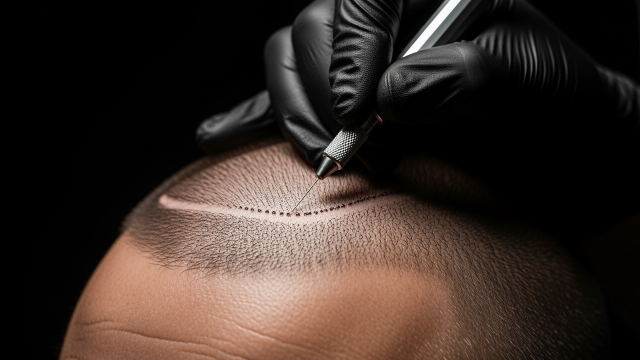
Scalp micropigmentation places pigment into the scalp to create the appearance of increased hair density and improved hairline definition. That is what it does. It does not change the biology of the follicles underneath, and it is not aimed at doing so.
Return Clinic describes suitable candidates for its scalp work as adults with visible hair thinning, receding hairlines, bald patches, widened part lines or scalp scars, and it describes patients seeking the treatment to improve the appearance of thinning hair, hairline recession, bald areas or scalp scars while avoiding surgery.
So the fit is specific: it is an appearance treatment for a visible presentation, chosen by someone who has decided against a surgical route.
When it is the right answer
Four conditions, and they are worth checking honestly against your own situation.
When the medical question is settled. Either the cause has been established as pattern loss, or anything else requiring treatment has been addressed. This is first because it is a prerequisite rather than a factor.
When your complaint is about how it looks. If what bothers you is the appearance of density and definition, an appearance treatment is aimed at your actual complaint.
When you do not want surgery. The clinic's own account of why patients seek it puts avoidance of a surgical route at the center, and that is a legitimate and common reason.
When your expectations match what it does. It creates an appearance. A patient hoping for biological change will be disappointed by a technically excellent result, and that disappointment is preventable by being clear at the outset.
When it is not
Equally worth stating, because a treatment recommended in the wrong circumstances is the most common source of regret.
When the cause has not been established. Covered above, and it is the clearest case.
When there is an active scalp condition. The clinic names untreated scalp conditions as a reason someone is not yet a candidate.
When what you want is more hair. Not a fuller appearance — more hair. That is a different category of treatment with different options, and the Academy's material on treatments for male pattern loss describes what is available on that front.
When the loss is moving quickly and you have not discussed what that means. A design suited to today's presentation sits within a scalp that continues to change. That is a live consultation topic rather than a reason not to proceed, but it should be a discussed topic rather than an assumed one.
Two conversations, not one
The most useful thing this article can leave you with is that you are having two separate conversations, and conflating them is what goes wrong.
The first is medical: what is happening, why, and is anything about it treatable. It has a diagnostic answer and it comes first.
The second is cosmetic: given what is happening, what do you want it to look like, and what is the best route to that. It has a preference component, and your own priorities are legitimate inputs to it.
Patients who arrive having already merged the two — who arrive asking for a treatment rather than describing a situation — get an answer to the second question with the first one still open. That is how someone ends up with a good cosmetic result over an untreated cause, which is the outcome the clinic's own candidacy rule exists to prevent.
You can start the first conversation before you travel, through the clinic's contact page, by describing what you have noticed rather than what you want done about it.
What to look at while you decide
Two things are worth your time before any appointment.
Read a dermatology association's own material on the condition rather than a clinic's, including this one. A body with no service to sell describes the condition differently, and the difference is instructive.
Then look at the clinic's before-and-after gallery, which is organized by category, and find the entries closest to your own presentation. What you are checking is not whether the work is good but whether the kind of change shown is the kind of change you want. Those are different questions, and only the second one is about you.
Understand the condition before choosing the response
The framing worth carrying into all of this is that male pattern hair loss is a process rather than an event, and the response to a process is a plan rather than a purchase.
A man who understands what is happening to his own scalp — which follicles are miniaturizing, how fast, and whether anything else is contributing — is in a position to choose among the available responses, including the response of doing nothing for now.
A man who has skipped that step is choosing between marketing descriptions. He may still land on the right treatment, but he will not know why it was right, and he will have no basis for judging the result against anything except hope.
The diagnostic step is not an obstacle placed before the treatment you want. It is the thing that makes the treatment you want a decision rather than a guess.
The Bottom Line
- Male pattern hair loss involves follicles progressively miniaturizing rather than simply disappearing, which is why what looks empty may not be.
- Return Clinic states that untreated scalp conditions or medical causes requiring diagnosis are a reason someone is not yet a candidate for its cosmetic scalp work — so diagnosis comes first.
- The clinic's scalp assessment examines condition, hair-loss progression and hair-root distribution; bring dated photographs and a family history.
- Scalp micropigmentation creates the appearance of increased density and improved hairline definition; it does not change the biology underneath.
- It fits when the medical question is settled, the complaint is about appearance, surgery is not wanted, and expectations match what the treatment does.
Frequently Asked Questions
What is male pattern hair loss?
It is the most common cause of hair loss in men, in which follicles progressively shrink and produce finer, shorter hairs over successive cycles. It typically affects the temples, front and crown while sparing a band at the sides and back.
How do I know that is what I have?
By having it assessed rather than assumed. The pattern is recognizable, but loss that is sudden, patchy, or accompanied by irritation or scaling points elsewhere, and there are many other causes.
Why does the diagnosis have to come first?
Because Return Clinic states that untreated scalp conditions or medical causes of hair loss requiring diagnosis are a reason someone is not a candidate for the cosmetic route, and because covering an untreatable-looking problem that was treatable is the worst available outcome.
What does the clinic's assessment look at?
Scalp condition, hair-loss progression and hair-root distribution, as part of a personalized scalp assessment.
What does SMP actually do for this condition?
It creates the appearance of increased hair density and improved hairline definition. It is an appearance treatment and does not alter what is happening to the follicles.
Who is described as a suitable candidate?
Adults with visible hair thinning, receding hairlines, bald patches, widened part lines or scalp scars, typically seeking to improve appearance while avoiding a surgical route.
What if my hair loss is still progressing?
That is a consultation topic rather than a disqualification. A design suited to today sits in a scalp that continues to change, so it should be discussed explicitly rather than assumed either way.
What should I bring to the appointment?
When you first noticed the change, whether it has been steady or episodic, family history, anything else that changed around the same time, and dated photographs in similar lighting.
This article is for general informational purposes and does not constitute individualized medical advice. It is not a self-diagnosis tool. The cause of hair loss and the suitability of any treatment can only be determined through a consultation with a qualified dermatologist or other appropriately qualified clinician who has examined your scalp in person.
More Articles
Continue exploring hair restoration and skin rejuvenation insights from Return Clinic.

Return Clinic's Non-Surgical Options Compared by Concern
Return Clinic's Non-Surgical Options Compared by Concern Medically reviewed by Dr. Hyung Geon Kim, M.D., Ph.D., Board-Certified Internal Medicine Specialist A clinic menu is organized by what the clinic does.
Learn More
SMP scalp tattoo guide to Korea from Beijing: Guide to appointments, face-to-face consultations and return journeys
北京去韩国做SMP头皮纹发:行程、预约与术后返程规划 医学审核 Dr. Hyung Geon Kim, 医学博士,内科专科医师 要点总结 京首双城短途直飞优势 :从北京首都国际机场或北京大兴国际机场出发,直飞首尔金浦国际机场或仁川国际机场的航程仅需约两小时左右;这一便捷的交通条件使 北京去韩国做SMP 成为周末短途或小长假出行的可行选择。
Learn More

Is Scalp Micropigmentation Painful? A Straight Answer
Is Scalp Micropigmentation Painful? A Straight Answer Medically reviewed by Dr. Hyung Geon Kim, M.D., Ph.D., Board-Certified Internal Medicine Specialist Pain is near the top of what US patients ask Return…
Learn More