Medical SMP, Stem Cell Hair Restoration & Skin Rejuvenation in Gangnam, Seoul · Multilingual Concierge
1:1 Personalized Care by Dr. Hyung Geon Kim, M.D., Ph.D.
en-US


Clinical Guide
SMP vs Hair Transplant: Which Is Right for Your Hair Loss?
SMP vs Hair Transplant: Which Is Right for Your Hair Loss? Medically reviewed by Dr. Hyung Geon Kim, M.D., Ph.D., Board-Certified Internal Medicine Specialist These two options get compared constantly and they…
Schedule a ConsultationSMP vs Hair Transplant: Which Is Right for Your Hair Loss?
Medically reviewed by Dr. Hyung Geon Kim, M.D., Ph.D., Board-Certified Internal Medicine Specialist
These two options get compared constantly and they are not really competitors. One is a cosmetic procedure that changes how dense your hair looks. The other is surgery that moves hair from one part of your head to another.
Return Clinic states the distinction from its own side without hedging: its approved claim for scalp micropigmentation is that the procedure creates the appearance of increased hair density and improved hairline definition, and that it does not regrow hair.
That sentence settles more of this comparison than any feature table. What follows is why, and what to do with it.
What each one physically does
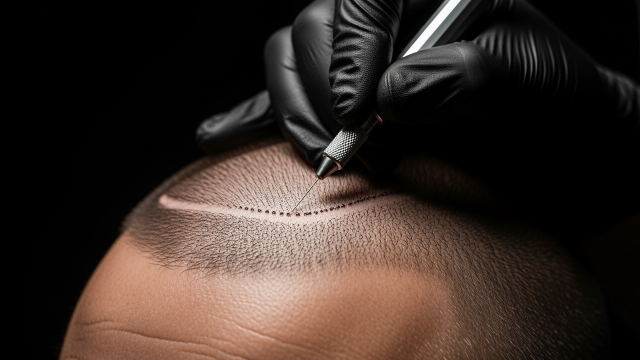
Scalp micropigmentation places pigment impressions in the scalp. Return Clinic describes its technique as following the direction and thickness of existing hair rather than relying on uniform dots alone. Nothing is added that grows; the change is optical.
Hair transplantation is a surgical procedure that relocates follicles from a donor area to a recipient area. The American Academy of Dermatology's material on hair transplants describes what the procedure involves. The relocated follicles continue to behave as the follicles they were — they grow, they need cutting, and they are yours in a way pigment is not.
Everything below follows from that one difference.
The practical comparisons
Time to a visible result. SMP is visible immediately; the clinic states results become visible after treatment, with the final appearance depending on completing the recommended sessions. Transplanted hair has to establish and grow, which is a matter of many months.
Recovery. SMP recovery is described as generally minimal with temporary scalp sensitivity possible, and most patients resume normal activities shortly after. A surgical procedure has a surgical recovery.
What it leaves behind. Transplantation takes tissue from somewhere, and donor-site scarring is part of what it leaves — which is, not coincidentally, one of the things people later use pigment to address.
Maintenance. The clinic describes SMP results as lasting several years depending on skin type and maintenance, which implies periodic attention. Transplanted hair does not fade, but the untransplanted hair around it keeps doing whatever it was doing.
What happens as loss progresses. This one catches people out with both options. Pigment marks a position; hair loss continues behind it. Transplanted follicles persist; the native hair around them may not. Neither procedure pauses the underlying process.
What each one asks of your time
Worth laying out plainly, because it is where an international patient's decision is often actually made.
Pigmentation is delivered over multiple sessions of a few hours each, with the clinic stating that session count and treatment time vary with scalp condition and area. Recovery is described as generally minimal, with temporary scalp sensitivity possible, and many patients able to travel shortly after treatment if the clinic clears them. The result is visible immediately and refines as the sessions complete.
Transplantation is a surgical day with a surgical recovery, followed by a long wait. Relocated follicles do not produce a visible result quickly; the meaningful assessment point is many months out, by which time an international patient is long home.
For someone weighing a trip, those two profiles suggest different things. A treatment whose result is visible before you fly home is a different proposition from one whose result you will assess alone, months later, with no way to be examined.
That is not an argument for the easier option. It is an argument for being honest about which one your circumstances can actually support.
The comparison that actually matters
Strip away the features and the real difference is what you are buying.
SMP buys appearance. It is reliable at what it does, it does it immediately, and it does not pretend to be anything else — the clinic's own claim language is explicit about the boundary.
Transplantation buys hair. It is slower, it is surgery, and it is limited by a resource that is genuinely finite: the donor area. There is only so much hair available to move, and moving it is not reversible.
That last point deserves more weight than it usually gets in comparison articles. A cosmetic pigmentation decision can be revisited. A donor area cannot be restocked.
Where they overlap
Three situations where both are genuinely on the table.
Diffuse thinning with hair still present. Pigment between existing hairs reduces the contrast that makes thinning visible, and it does so without consuming a donor supply. This is where SMP is at its most efficient.
A hairline decision. Both can address a receding hairline, and the trade is immediacy and reversibility against real hair.
After a transplant. Pigment is frequently used to increase apparent density between transplanted hairs, or to address the donor scar. The clinic positions its hair and SMP services as complementary rather than exclusive.
And one situation where they are not really alternatives: a scalp with no remaining follicles in the area of concern. Pigment can create an impression of density there; nothing grows from it. Whether that is enough is a personal answer, but it is not a comparison.
The finite resource nobody mentions early enough
One asymmetry between these options deserves its own section, because it is the part that cannot be undone and it rarely appears until late in a consultation.
Transplantation moves hair. It does not create it. The hair comes from a donor area, that area contains a finite quantity, and what is taken from it does not grow back there.
Several things follow that are worth knowing before you compare anything else.
Your donor supply caps what surgery can ever achieve. Two people with identical visible loss can have very different options, because one has a dense donor area and the other does not.
Spending it early constrains you later. Hair loss is progressive. A donor area drawn on at thirty is a smaller resource at forty-five, when the pattern has advanced and the need may be greater.
Pigmentation spends nothing. Whatever else is true about it, this option leaves your choices intact. It does not consume donor supply, and a patient who has had it can still pursue surgery afterward.
That asymmetry does not make one option better. It makes them differently reversible, and reversibility is worth weighing explicitly rather than discovering afterward. It is also why the sequencing question -- if you are considering both -- is a real clinical conversation rather than a scheduling one.
What both require first
Return Clinic's position is the same regardless of which route you are considering: people with untreated scalp conditions or medical causes of hair loss that require diagnosis and treatment first are not suitable.
This is the step people most want to skip, and it is the one that most often changes the answer. Hair loss has many causes — the AAD's material runs to a long list — and several are treatable. A diagnosis can alter what you would want done, and occasionally removes the need for either procedure.
Someone choosing between SMP and transplantation without knowing why they are losing hair is optimizing a decision they have not yet established the premise for.
Replace the comparison with a different question
Here is the move that resolves this faster than any amount of feature-weighing, and it is the reason this page exists.
Stop asking which procedure is better. Ask instead: what would have to be true for me to be satisfied in five years?
That question sorts people almost immediately, because the answers are genuinely different.
"I want to look like I have more hair, and I am comfortable maintaining that." You are describing SMP. It delivers exactly this, immediately, without consuming a finite resource, and the maintenance is the price of the immediacy. A patient who answers this way and chooses surgery has bought a longer, more invasive route to a goal that did not require it.
"I want hair I can grow, cut and run my hands through." You are describing transplantation, and no amount of skilled pigmentation will satisfy you. A patient who answers this way and chooses SMP will be pleased with photographs and dissatisfied in person, which is a specific and avoidable kind of unhappiness.
"I do not know what is happening to my hair." You are describing neither yet. This is a diagnosis, and both clinics will tell you the same thing.
"Both, in some order." Common, and legitimate. The sequencing is a clinical conversation, and it is worth having it as one conversation rather than as two separate consultations that each assume their own answer.
Notice that none of those four is resolved by comparing recovery times or costs. They are resolved by knowing what you actually want, which is information you already have and probably have not written down.
So write it down before you consult anyone — one sentence about what satisfied looks like in five years. Bring that, along with what you know about why your hair is thinning, to the contact page. The about page describes the practice that will be reading it, which is worth a look before you decide how far to take the conversation.
The Bottom Line
- The clinic's own approved claim is that SMP creates the appearance of increased density and improved hairline definition and does not regrow hair; transplantation relocates follicles surgically.
- SMP is immediate, non-surgical, maintained over years, and does not consume a donor supply; transplantation is slower, surgical, and limited by a finite donor area that cannot be restocked.
- Neither pauses the underlying hair loss, so both have to be planned against where the pattern is going.
- They genuinely overlap on diffuse thinning, on hairline decisions, and after a transplant, where pigment is often used alongside.
- Replace "which is better" with "what would have to be true for me to be satisfied in five years" — that question sorts people immediately.
Frequently Asked Questions
Will SMP make my hair grow back?
No. The clinic's approved claim states explicitly that it creates the appearance of increased hair density and improved hairline definition and does not regrow hair.
Which gives a faster result?
SMP. Results are visible after treatment, with the final appearance depending on completing the recommended sessions. Transplanted hair must establish and grow over many months.
Which has the easier recovery?
SMP. The clinic describes recovery as generally minimal with temporary scalp sensitivity possible, and most patients resume normal activities shortly after treatment.
Can I have both?
Yes, and it is common — pigment is often used to increase apparent density between transplanted hairs or to address donor-site scarring. Sequencing is a clinical conversation.
Does either one stop my hair loss?
No. Pigment marks a position while loss continues behind it; transplanted follicles persist while native hair around them may not. Both have to be planned against the pattern's direction.
What is the biggest irreversible factor?
The donor area. There is a finite amount of hair available to move and it cannot be restocked, which makes transplantation the less revisable of the two decisions.
What should I establish before choosing either?
Why you are losing hair. The clinic will not treat over an untreated medical cause, and a diagnosis can change what you would want done.
How do I decide between them?
Ask what would have to be true for you to be satisfied in five years. Wanting to look like you have more hair points one way; wanting hair you can grow and cut points the other.
This article is for general informational purposes and does not constitute individualized medical advice. It is not a self-diagnosis tool. Which approach suits your hair loss can only be determined through a consultation with a qualified dermatologist or other appropriately qualified clinician who has examined your scalp in person.
More Articles
Continue exploring hair restoration and skin rejuvenation insights from Return Clinic.

Return Clinic's Non-Surgical Options Compared by Concern
Return Clinic's Non-Surgical Options Compared by Concern Medically reviewed by Dr. Hyung Geon Kim, M.D., Ph.D., Board-Certified Internal Medicine Specialist A clinic menu is organized by what the clinic does.
Learn More
SMP scalp tattoo guide to Korea from Beijing: Guide to appointments, face-to-face consultations and return journeys
北京去韩国做SMP头皮纹发:行程、预约与术后返程规划 医学审核 Dr. Hyung Geon Kim, 医学博士,内科专科医师 要点总结 京首双城短途直飞优势 :从北京首都国际机场或北京大兴国际机场出发,直飞首尔金浦国际机场或仁川国际机场的航程仅需约两小时左右;这一便捷的交通条件使 北京去韩国做SMP 成为周末短途或小长假出行的可行选择。
Learn More

Is Scalp Micropigmentation Painful? A Straight Answer
Is Scalp Micropigmentation Painful? A Straight Answer Medically reviewed by Dr. Hyung Geon Kim, M.D., Ph.D., Board-Certified Internal Medicine Specialist Pain is near the top of what US patients ask Return…
Learn More