Medical SMP, Stem Cell Hair Restoration & Skin Rejuvenation in Gangnam, Seoul · Multilingual Concierge
1:1 Personalized Care by Dr. Hyung Geon Kim, M.D., Ph.D.
en-US


Scalp Micropigmentation (SMP) · Consultation Required
Medical SMP Hair Loss Care
Scalp micropigmentation occupies a distinct position and is not a substitute for medical or surgical hair-loss management.
Schedule a ConsultationWhat Is Medical SMP Hair Loss Care in Scalp Micropigmentation?

Medical scalp micropigmentation is a non-surgical cosmetic procedure in which specialised pigment is deposited into the upper dermal layer of the scalp in thousands of individual micro-dots. Each dot is sized, shaded and angled to replicate the visual appearance of a natural hair follicle emerging from the skin. The combined effect reduces the visual contrast between scalp and hair, so thinning areas read as denser and scarred areas read as less visible. SMP does not grow hair and does not alter the biology of the follicle — it is a visual restoration procedure, not a hair-growth treatment.
The procedure works on a simple optical principle. Hair loss becomes visible not when hair count drops, but when scalp becomes visible through the remaining hair — the pale scalp beneath dark hair creates contrast, and contrast is what the eye reads as "thinning." By introducing controlled pigment into the scalp at a matched tone, that contrast is reduced. On a closely shaved head, the micro-dots read as short stubble across the whole scalp. On a scalp with existing hair, the pigment sits between and behind surviving hairs, creating a shadow effect so the remaining hair appears fuller than it would against bare skin. This is why SMP is often described as a density illusion rather than a density increase.
Who Is a Good Candidate for Medical SMP Hair Loss Care?
Scalp micropigmentation suits a wide range of hair-loss presentations, but it is not appropriate for everyone, and candidacy is confirmed at consultation rather than assumed. In general, the strongest candidates are those whose hair loss has a visible scalp-contrast component, whose scalp is in a stable and non-inflamed condition, and whose expectations align with what a visual camouflage procedure can realistically deliver.
Medical SMP is commonly considered by:
- Men in their 20s to 60s with androgenetic alopecia who are experiencing a receding hairline, temporal recession, crown thinning, or progressive scalp show-through, and who want an immediate visual improvement without committing to surgery.
- Men who already keep their hair very short or shaved and want the whole scalp to read as evenly dense stubble rather than as a bald crown with a horseshoe of remaining hair.
- Women in their 30s to 60s with diffuse thinning — particularly a widening parting, thinning across the mid-scalp, or scalp visibility under bright or overhead lighting — who want density blending rather than a shaved-look result.
- Patients with hair transplant scarring, including linear donor-strip scars and scattered FUE punch scarring, who find that the scarring itself has become the visible concern.
- Patients with traumatic or post-surgical scalp scars in a stable, fully healed state who want the scar to blend into surrounding hair-bearing scalp.
- Patients with stable, non-active patch alopecia where the affected areas have been unchanged for an extended period and camouflage is being considered as a cosmetic option.
- Patients who have found ongoing hair-loss routines frustrating — those tired of concealer fibres that transfer onto pillows and collars, or of styling their hair around a thinning zone every morning, and who want a result that is present without daily maintenance.
- Patients whose scalp condition is itself part of the problem — heavy keratin buildup with extreme dryness, an oily and inflamed scalp environment, or noticeably enlarged follicular openings with increased shedding — and who want the underlying scalp addressed alongside the cosmetic result.
Meet the Medical Team Behind Scalp Micropigmentation at Return Clinic
Medical SMP Hair Loss Care at Return Clinic operates under formal physician oversight. Micropigmentation is delivered by trained clinical practitioners working within documented, physician-approved protocols, with medical screening, safety governance and systemic assessment led by the clinic's medical director.
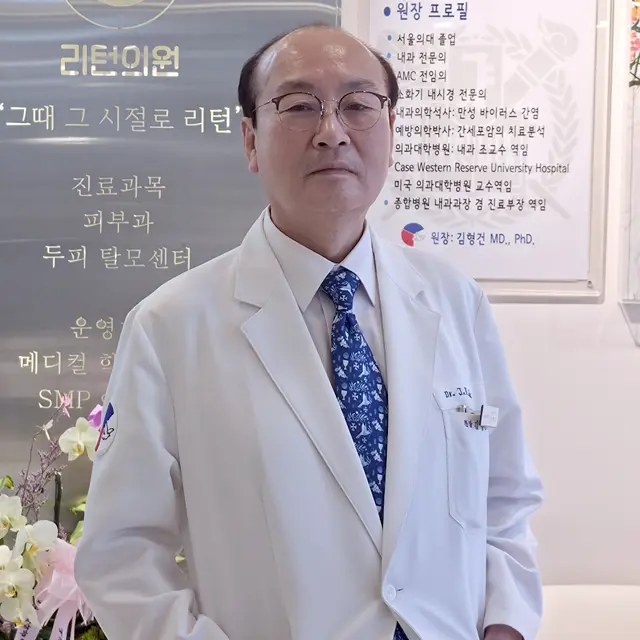
Dr. Hyung Geon Kim, M.D., Ph.D. — Medical Leadership
Dr. Kim is a board-certified Internal Medicine specialist and a certified Gastrointestinal Endoscopy subspecialist. He is a graduate of Seoul National University College of Medicine, and completed fellowship training at Asan Medical Center. He holds a Master's Degree in Internal Medicine, with research in chronic viral hepatitis, and a Ph.D. in Preventive Medicine, with research analysing hepatocellular carcinoma treatment. He has served as Assistant Professor in the Department of Internal Medicine at a medical university hospital, as Professor at Case Western Reserve University Hospital in the USA, and as Chief of Internal Medicine and Medical Director at a general hospital. His clinical specialties are gastroenterology, upper and lower endoscopy, liver disease including chronic hepatitis B and C, liver cirrhosis and fatty liver disease, the diagnosis and treatment of hepatocellular carcinoma, and general gastrointestinal disorders. He is a Gastrointestinal Endoscopy Subspecialist certified by the Korean Society of Gastrointestinal Endoscopy (Certification No. 99-533, valid 1 August 2025 – 31 July 2030) and a member of the Korean Society of Gastrointestinal Endoscopy.
Dr. Kim's role in the SMP pathway is medical rather than procedural. Hair loss is frequently influenced by factors beyond the scalp — chronic illness, hepatic and metabolic conditions, nutritional absorption, medication effects and systemic inflammation among them — and an internal medicine background is directly relevant to identifying when a patient's hair loss warrants medical investigation before or alongside cosmetic camouflage. His Ph.D. in Preventive Medicine underpins the clinic's approach to protocol design, screening standards and risk governance across the SMP service.
Clinical SMP Practitioner Team
Pigment placement is carried out by trained micropigmentation practitioners whose focus is hairline design, shade matching, dot calibration and scar work. Their responsibilities include mapping the treatment area, designing a hairline appropriate to the patient's facial proportion and likely hair-loss progression, matching pigment tone to existing hair colour and skin tone, and building depth of coverage progressively across sessions. Follow-up assessment, healing review and touch-up planning are managed by the same practitioner wherever possible, so the person who designed your result is the person who refines it.
Shared care philosophy: the team works to a conservative, evidence-informed, patient-centred standard in which the underlying scalp is assessed and supported before appearance is addressed, treatment is built gradually so it can be adjusted rather than corrected, and no patient is advised toward a procedure that their presentation does not genuinely call for.
Scalp Micropigmentation Treatment Areas and Expected Improvements
Medical SMP is mapped to specific zones of the scalp, and each zone carries its own design considerations, technique adjustments and realistic expectations.
- Frontal hairline and temporal points: The hairline is the single most scrutinised area of any SMP result, because it is the boundary the eye reads first and the feature that most strongly signals age. Design work here involves selecting a hairline height and shape appropriate to facial proportion, deciding how soft or defined the leading edge should be, and building an irregular, broken front edge rather than a straight line — natural hairlines are never geometric. Temporal points and temporal recession are addressed as part of the same design, since restoring a hairline without balancing the temples produces a result that reads as artificial from any angle other than straight-on.
- Mid-scalp and parting line: This is the zone where diffuse thinning becomes visible earliest under overhead lighting, and it is the primary treatment area for many female patients. Work here is density-focused rather than outline-focused: pigment is placed between surviving hairs to reduce the pale scalp visible through the parting, so the existing hair appears to have more behind it. The technique requires a lighter hand and more precise shade matching than shaved-look work, because pigment must sit convincingly alongside real hair rather than replace it visually.
- Vertex and crown: The crown presents a particular technical challenge because hair here grows in a whorl pattern radiating outward from a central point, and pigment placement must follow that natural directional flow to look convincing. Crown thinning also tends to be circular and progressive, meaning the transition from treated to untreated scalp needs careful gradation — an abrupt edge at the perimeter of the crown is immediately obvious. Coverage is built across multiple sessions specifically so this blending can be judged and refined once initial healing has settled.
- Hair transplant scarring — donor and recipient sites: Linear strip-harvest scars and scattered FUE punch scars are camouflaged by depositing pigment into and around the scar tissue to reduce the tonal difference between the scar and the surrounding scalp. Scar tissue behaves differently from healthy skin: it may retain pigment unevenly, absorb more or less than expected, and often requires additional sessions and more conservative saturation. Realistic expectation-setting matters here — the aim is meaningful reduction in visibility, not erasure, and results are influenced by scar age, texture and depth.
- Full shaved-look coverage: For patients with advanced pattern loss who keep their hair closely shaved, pigment is applied across the entire affected scalp so the whole head reads as uniform, freshly shaved stubble. This eliminates the visual division between bald crown and remaining side and back hair, which is often the most ageing aspect of advanced hair loss. Careful blending into the existing hair at the sides and back is essential, and shade is calibrated to sit slightly lighter than the natural hair to remain believable.
- Traumatic and post-surgical scalp scars: Stable, fully healed scars from injury or prior surgery are treated with the same tone-matching principle as transplant scarring. Assessment focuses on whether the scar is mature, whether the surrounding scalp is healthy, and whether the scar's texture will hold pigment predictably. Some scars respond very well; others improve partially. This is assessed and discussed honestly before treatment begins.
Expected improvements. Patients most commonly report a reduction in visible scalp show-through, a more defined and balanced hairline, less obvious scarring, reduced contrast between hair and scalp under bright or overhead light, and a general sense that hair loss is less noticeable in photographs and social settings. Many also describe a practical benefit — no longer arranging hair to conceal a thinning zone, and no longer relying on concealer products. Results vary considerably by individual, and no outcome is guaranteed. Skin type, existing hair colour and density, scalp condition, scar characteristics, healing response, sun exposure and individual pigment retention all influence the final appearance. Your consultation will set expectations specific to your presentation rather than to a general average.
The Scalp Micropigmentation Treatment Process and Timeline
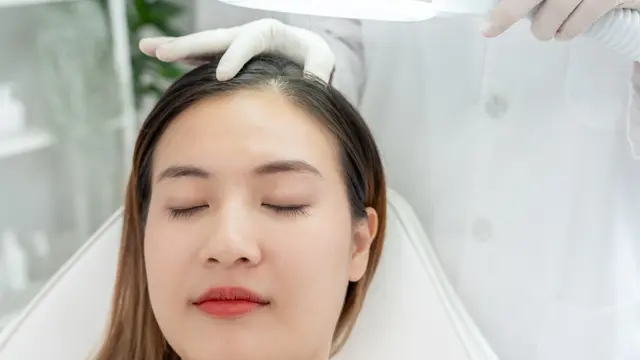
Medical SMP at Return Clinic is delivered as a structured, staged pathway rather than a single appointment. The layered approach exists for a clinical reason: pigment can always be added at a later session, but removing or lightening over-saturated pigment is far more difficult. Building gradually keeps the result adjustable.
- Consultation, scalp analysis and medical screening: Your first visit begins with assessment of your hair-loss pattern, scalp condition, skin tone, hair colour and the areas causing you most concern. Scalp condition is categorised — whether the dominant issue is keratin and dead-skin buildup with dryness, inflammatory oiliness, or age-related follicular pore dilation — as this influences both preparation and aftercare. Medical screening covers relevant history including skin conditions, keloid tendency, medications, bleeding risk, allergies and any systemic factors that may be contributing to hair loss. Where hair loss appears to warrant medical investigation, this is raised directly.
- Design, shade matching and treatment mapping: Before any pigment is placed, the hairline is drawn onto the scalp and reviewed with you in a mirror, in good lighting, and typically photographed from several angles. Height, shape, temporal balance and edge softness are agreed at this stage. Pigment shade is matched to your natural hair colour and skin tone, and a test placement may be made in a discreet area. Nothing proceeds until the design is agreed — this review stage is where most patient dissatisfaction is prevented.
- Scalp preparation and stabilisation: Where scalp condition requires it, a preparation period is advised before the first pigment session. Return Clinic's in-house functional scalp cleanser is formulated at pH 5.0–6.0 to support the scalp's natural acid mantle, with alpha lipoic acid to help address keratin buildup and dryness, salicylic acid, zinc pyrithione, dexpanthenol, pyridoxine, niacinamide and allantoin. The purpose is to bring the scalp into a calmer, better-balanced state so pigment settles more predictably and healing is more comfortable.
- First pigment session: The initial session establishes the foundation layer — base coverage and preliminary hairline placement, applied at a deliberately conservative saturation. Depending on the size of the treatment area, a session typically runs between two and four hours. Topical numbing is generally used, and most patients describe the sensation as tolerable pinpricking rather than sharp pain, with the hairline and any scarred areas usually the most sensitive zones. You leave with the treated area visible and slightly red.
- Immediate aftercare and healing: Expect redness across the treated scalp and pinpoint scabbing over roughly the first two to five days. The scalp should be kept dry for the first several days, with washing, sweating, gym sessions, swimming, saunas and direct sun exposure avoided for the period advised at your appointment. Picking or scratching scabs must be avoided, as this is the most common cause of patchy retention. The pigment will look darker and sharper initially and will soften as healing completes — this settling is expected, not a fault. Most patients return to work and normal social activity immediately, since there is no wound and no dressing.
- Subsequent sessions and follow-up: Additional sessions are spaced to allow full healing between visits, commonly with one to three weeks between appointments, and most patients complete two to four sessions in total. Each session assesses how the previous layer healed and retained, then adds depth, refines the hairline, blends transitions and addresses any areas of uneven retention. Once the full course is complete, a follow-up review confirms the settled result and establishes a maintenance plan.
Scalp Micropigmentation Results, Safety, and Longevity
SMP results are visible immediately after the first session and continue to develop across the treatment course as layers are added and healing settles. The result is generally considered semi-permanent rather than permanent. Pigment in the scalp gradually lightens over a period commonly measured in years rather than months, with individual retention varying substantially — sun exposure is the most significant accelerating factor, followed by skin type, immune response, the depth and saturation originally placed, and individual metabolism of pigment. Most patients plan for periodic refresh sessions to restore depth of shade as it softens. Because the fade is gradual and even rather than patchy, many patients find refresh timing is a matter of preference rather than urgency. We do not describe SMP results as permanent, and no specific duration can be guaranteed for any individual.
The safety profile of medical SMP compares favourably with surgical hair-loss options, largely because there is no incision, no graft harvest, no general anaesthesia and no surgical wound. Return Clinic's approach is deliberately conservative on the two variables that most influence long-term safety and appearance: depth of placement and saturation. Placing pigment too deeply is what causes dots to spread and blur over time, and over-saturating in a single session is what produces results that look heavy or unnaturally dark once healed. Building in light, assessable layers is slower — and it is the reason a course is planned across several sessions rather than compressed into one. Sterile single-use needle cartridges, documented hygiene procedure, and physician-approved protocols apply to every session.
Possible side effects should be understood before you proceed. Expected short-term effects include redness, tenderness, mild swelling, pinpoint scabbing and temporary itching as healing completes. Less common but possible complications include patchy pigment retention requiring additional correction, pigment spread or blurring where placement was too deep, a shift in pigment tone toward a cooler or warmer hue over time, folliculitis or localised infection, allergic or hypersensitivity reaction to pigment, and keloid formation in predisposed individuals. Dissatisfaction with hairline design is also a genuine risk, which is why the design review stage is treated as a decision point rather than a formality. Serious complications are uncommon, but they are possible. Contact the clinic promptly if you develop spreading redness, increasing pain after the first few days, pus or discharge, fever, or any reaction that concerns you — and seek urgent medical care if you experience signs of a significant infection or systemic allergic reaction. Scalp micropigmentation is a cosmetic procedure, and the decision to proceed should follow individual assessment by a qualified professional rather than general information on a website.
Why Choose Return Clinic for Medical SMP Hair Loss Care?
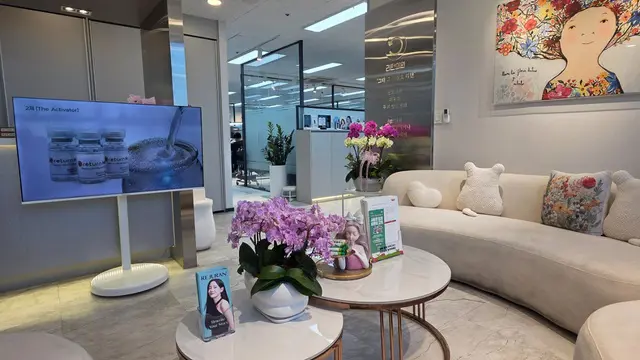
Return Clinic approaches hair loss as a scalp condition first and an appearance concern second. That ordering is not a slogan — it shapes how the SMP pathway is built. Before pigment is placed, the state of the scalp is assessed and categorised, because a scalp carrying heavy keratin and dead-skin buildup, a scalp in an inflamed and heavily oily state, and a scalp showing age-related follicular pore dilation each hold and heal pigment differently. Addressing the scalp environment first is what makes the cosmetic result more predictable and the healing period more comfortable.
That scalp-health focus is grounded in the clinic's own research work. Return Clinic developed its functional scalp cleanser in-house, drawing on hair-loss clinical experience accumulated across a large patient volume, and formulated it around alpha lipoic acid — a compound with recognised antioxidant activity that supports both water-soluble antioxidants such as vitamin C, glutathione and uric acid, and fat-soluble antioxidants such as vitamin E, coenzyme Q10 and carotenoids. The formulation is completed with salicylic acid, zinc pyrithione, dexpanthenol, pyridoxine, niacinamide and allantoin, and is manufactured at pH 5.0–6.0 to support the scalp's natural acid mantle rather than strip it. It uses naturally derived surfactants at EWG green grade, and holds Korean MFDS functional cosmetic approval for hair-loss symptom relief, vegan certification, and China NMPA hygiene approval. Within the SMP pathway, this formulation is used for pre-treatment scalp preparation and post-treatment maintenance — supporting the environment the pigment sits in, not the pigment itself.
Medical governance sits above the cosmetic procedure rather than beside it. Dr. Hyung Geon Kim's background in internal medicine, hepatology and preventive medicine means the clinic is equipped to recognise when a patient's hair loss reflects something beyond the scalp and warrants medical investigation — an assessment step many purely cosmetic SMP providers are not positioned to make. For patients travelling internationally for treatment, the clinic offers English-language support throughout the pathway, from initial consultation and design review to aftercare instructions and follow-up scheduling, with session planning arranged around travel timelines where possible.
Clinic USPs:
- Scalp-first clinical protocol: Scalp condition is assessed and categorised before pigment work begins, and supported afterwards with an in-house functional scalp formulation developed specifically for hair-loss patients.
- Physician-supervised medical governance: Screening, protocol design and safety standards are directed by a Seoul National University College of Medicine graduate holding an M.D. and a Ph.D. in Preventive Medicine, with prior professorial appointments in Korea and the USA.
- Conservative layered technique: Treatment is delivered across multiple assessable sessions at controlled depth and saturation — prioritising a result that ages well over one that looks maximally dark on day one.
- International patient support: English-language consultation, design review, written aftercare guidance and follow-up coordination, with session scheduling arranged around international travel where practical.
Patient Experiences with Medical SMP Hair Loss Care
The following are anonymised composite examples reflecting typical presentations and outcomes at Return Clinic. They are illustrative patient profiles, not verified individual testimonials, and they are not a prediction of any individual result.
Composite Profile — Crown and Hairline SMP, Male, Late 30s
A patient in his late thirties presented with progressive crown thinning and temporal recession that had become noticeably more visible in photographs over the previous two years. He had been keeping his hair longer on top to cover the crown and found the daily styling increasingly frustrating. Assessment identified an oily, mildly inflamed scalp environment, which was stabilised before treatment began. A conservative hairline was designed with a deliberately soft, broken front edge to accommodate likely future progression, and coverage was built across three sessions. At his follow-up review, he reported that the contrast between his scalp and hair under office lighting had reduced substantially and that he had cut his hair shorter for the first time in several years.
Composite Profile — Density SMP for Diffuse Thinning, Female, Early 50s
A patient in her early fifties presented with diffuse thinning across the mid-scalp and a parting line that had widened gradually over several years, most visible in bright daylight and in photographs taken from above. She was not seeking a shaved-look result and specifically wanted her existing hair to appear fuller rather than replaced. Assessment identified significant keratin buildup with scalp dryness, which was addressed with a preparation period before pigment work. Density pigment was placed between existing hairs across two sessions with careful shade matching. She described her parting as considerably less noticeable and reported feeling more comfortable in overhead lighting and in group photographs.
Take the Next Step Toward Medical SMP Hair Loss Care
Your hair loss deserves an honest assessment before it gets a cosmetic solution.
Book your Medical SMP consultation with Return Clinic and receive a full scalp assessment, hair-loss pattern evaluation and medical screening — followed by a clear, individually designed treatment plan covering hairline design, expected session count, realistic outcomes, maintenance requirements and total cost, with no obligation to proceed and no pressure at any stage. You will leave the consultation knowing exactly what scalp micropigmentation can and cannot do for your specific presentation, and whether it is genuinely the right option for you.
Prefer to speak with someone first? Call the Return Clinic patient coordination desk to discuss your hair-loss concerns, ask about the SMP treatment process, request English-language support, or arrange a consultation time around international travel. Our coordination team can answer practical questions about scheduling, session spacing and aftercare before you commit to an appointment.
Individual clinical results and recovery timelines may vary depending on scalp/skin condition and personalized treatment planning. Temporary redness, mild swelling, or tenderness may occur following treatment.
Related Treatments
Explore additional hair restoration, scalp micropigmentation, and skin rejuvenation procedures at Return Clinic.

Liftera-A2 HIFU Lifting
Liftera-A2 HIFU lifting is a non-surgical skin tightening procedure that uses high-intensity focused ultrasound to deliver heat energy to precise depths beneath the skin surface.
Learn More
Medical SMP Hair Loss Care
Scalp micropigmentation occupies a distinct position and is not a substitute for medical or surgical hair-loss management.
Learn More

SMP Hairline
SMP hairline treatment applies this technique specifically to the frontal hairline — the area that frames the face and is usually the first thing both the patient and other people notice.
Learn More