Medical SMP, Stem Cell Hair Restoration & Skin Rejuvenation in Gangnam, Seoul · Multilingual Concierge
1:1 Personalized Care by Dr. Hyung Geon Kim, M.D., Ph.D.
en-US


Scalp Micropigmentation (SMP) · Consultation Required
Men's SMP Hairline
A men's SMP hairline procedure can be confined to one small zone or extended across the entire scalp, and the plan is built around where the loss is most visible to the individual himself.
Schedule a ConsultationWhat Scalp Micropigmentation Is and How It Works?

Scalp micropigmentation, commonly shortened to SMP, is a non-surgical dermatological procedure in which extremely fine deposits of medical pigment are placed into the upper layer of the scalp. Each deposit is sized and spaced to imitate the look of a natural hair follicle emerging from the skin. Viewed as a whole, thousands of these points create the visual impression of closely-cropped hair, a sharper hairline edge, and greater density across areas where the scalp currently shows through. The men's SMP hairline treatment applies this technique specifically to the frontal border of the scalp — the area where hair loss is usually noticed first and felt most.
It is important to be clear about what this procedure does and does not do. Men's SMP hairline treatment does not grow hair, halt hair loss, or alter the biology of the follicle. It is a visual, appearance-based solution that changes how the scalp looks, not how it functions. For many men that distinction is exactly the appeal: the change is visible immediately after the first session, there is no waiting period of many months, and the outcome does not depend on how an individual responds to medication or grafting.
Who Needs Men's SMP Hairline Treatment?
Candidacy for a men's SMP hairline procedure is determined by the pattern and stability of hair loss, the condition of the scalp skin, and — just as importantly — what the individual actually wants his hairline to look like. Because SMP is appearance-based rather than growth-based, it suits men who are comfortable with a defined, short-hair aesthetic and who want a visible improvement without surgery. An individual consultation with a qualified practitioner is always required before treatment, as scalp condition, skin sensitivity, and medical history all influence suitability.
Men who commonly benefit from scalp micropigmentation of the hairline include:
- Men in their 20s to 60s with M-shaped hairline recession loss at the temporal points is one of the earliest and most recognisable patterns of male hair loss, and it changes the perceived shape of the entire face. SMP rebuilds a softer, more balanced frontal edge across those receded corners.
- Men with a receding or softening frontal hairline those who feel their face looks longer or older than it should, and who want the border between forehead and scalp redefined without committing to surgery.
- Men whose forehead appears wide or high whether through hair loss or natural proportion, the hairline can be visually lowered and reframed to better suit the rest of the face.
- Men with irregular or patchy partial hair loss along the hairline, where uneven gaps make styling difficult and draw attention to the scalp in bright light or in photographs.
- Men with diffuse thinning and visible scalp show-through, where hair remains but no longer provides enough coverage to disguise the skin beneath it.
- Men who have had a hair transplant and want to increase apparent density between grafts, blend transitional zones, or camouflage donor and recipient scarring while transplant results continue to mature.
- Men with advanced or near-total hair loss who prefer a clean, deliberately shaved appearance with a defined hairline, rather than continuing to manage thinning hair.
- Men with scalp scarring from previous procedures, injury, or surgery, who want the contrast between scar tissue and surrounding scalp reduced.
- Men tired of short-acting cosmetic workarounds such as daily concealer fibres, powders, sprays, or constant restyling to hide thinning areas, and who prefer a longer-lasting, low-maintenance approach.
- Men who want a natural, understated result rather than an obviously artificial one, and who are willing to complete a staged, multi-session protocol so that density is built gradually rather than forced in a single visit.
Meet the Specialist
Scalp micropigmentation sits at the meeting point of aesthetic technique and medical responsibility. Pigment is being placed into skin, which means hygiene standards, patient screening, medical history review, and complication awareness matter just as much as artistry. At Return Clinic, men's SMP hairline treatment is delivered within a clinical framework rather than a purely cosmetic one.
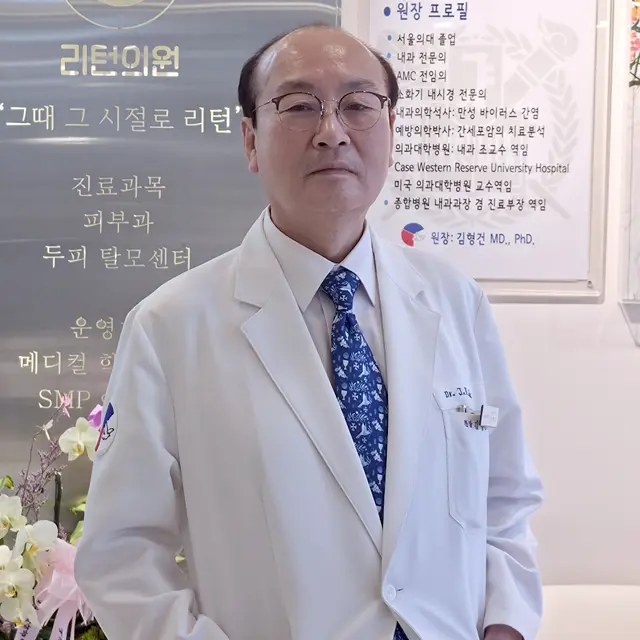
Dr. Hyung Geon Kim, M.D., Ph.D. — Medical Leadership
Dr. Kim is a board-certified Internal Medicine specialist and a certified Gastrointestinal Endoscopy subspecialist. He is a graduate of Seoul National University College of Medicine, holds a Master's Degree in Internal Medicine with research on chronic viral hepatitis, and a Ph.D. in Preventive Medicine with research analysing hepatocellular carcinoma treatment. He completed fellowship training at Asan Medical Center (AMC) and has served as Assistant Professor in the Department of Internal Medicine at a medical university hospital, as Professor at Case Western Reserve University Hospital in the USA, and subsequently as Chief of Internal Medicine and Medical Director at a general hospital.
His clinical practice centres on liver disease — including chronic hepatitis B and C, liver cirrhosis, and fatty liver disease — the diagnosis and treatment of hepatocellular carcinoma, general gastrointestinal disorders, and advanced diagnostic and therapeutic endoscopy including gastroscopy and colonoscopy. He is a Board-Certified Specialist in Internal Medicine and a Gastrointestinal Endoscopy Subspecialist certified by the Korean Society of Gastrointestinal Endoscopy (Certification No. 99-533, valid 1 August 2025 – 31 July 2030), of which he is a member.
Dr. Kim's contribution to the men's SMP hairline service is one of medical governance rather than pigment application: decades of hospital-based practice, academic appointment, and departmental leadership inform how the clinic screens patients, reviews medical history and medication, maintains sterile technique and single-use consumables, documents each session, and recognises when a patient should be referred for dermatological or medical assessment before a cosmetic procedure proceeds. Micropigmentation itself is performed by trained SMP practitioners working to these clinic protocols.
The shared philosophy across the team is straightforward: an aesthetic procedure should be held to medical standards, expectations should be described honestly before anything begins, and a natural, conservative result is always preferred to an aggressive one.
Men's SMP Hairline Treatment Areas and Expected Improvements
A men's SMP hairline procedure can be confined to one small zone or extended across the entire scalp, and the plan is built around where the loss is most visible to the individual himself. The following areas are the most frequently treated.
- The frontal hairline and forehead-scalp border: this is the defining line of the upper face and the area men are most conscious of in mirrors, photographs, and video calls. Micropigmentation here re-establishes a clear but soft edge, using irregular spacing and varied point density so the border never looks drawn or stencilled. Where the natural hairline has thinned into a vague fade, treatment restores the visual distinction between forehead and scalp, which in turn changes how the whole face reads.
- The temporal points and M-shaped recession: recession at the corners is what most often makes a man feel his hairline has "gone back," because it lengthens the visual forehead on both sides. SMP fills these two triangular zones with follicle-sized points that connect temple hair to the central hairline. The rebuilt corners are shaped conservatively and kept age-appropriate, since an overly low or overly square correction is the most common way this area is made to look unnatural.
- The mid-scalp and diffuse thinning zone: behind the hairline, thinning usually shows as scalp visible through remaining hair, especially under overhead light. Pigment placed between existing hairs reduces the contrast between skin and hair shafts, so the scalp no longer reads as an empty background. The result is an impression of fuller coverage without adding a single strand of hair, and it also makes shorter hairstyles far more wearable.
- The parting line: a widening parting exposes a long strip of scalp that draws the eye immediately. Micropigmentation along and around the parting narrows that visual gap by bringing the exposed skin closer in tone to the surrounding hair. For men who part their hair rather than wear it uniformly short, this is often the single change that makes the greatest difference to everyday appearance.
- The crown and vertex: crown loss is difficult to manage because it is seen by other people far more often than by the man himself. Treating this area brings its tone closer to the rest of the scalp and reduces the sharp circular contrast that makes crown thinning conspicuous from behind or above. Crown work can be carried out alongside hairline treatment or staged separately once the frontal result has settled.
- Irregular and patchy areas: uneven gaps along the hairline or scattered through the frontal region create a mottled appearance that resists styling. Pigment is placed selectively into these gaps at a density matched to the surrounding hair, evening out the pattern rather than covering the region uniformly. Careful, staged work matters here, because patchy zones need matching rather than blanket coverage.
- Scars and post-transplant areas: scalp scars, including linear donor scars and recipient-area marks, are typically paler and smoother than surrounding skin, which is precisely why they catch the light. Micropigmentation reduces that contrast by introducing tone and follicle-mimicking points across and around the scar. Scarred skin holds pigment differently from healthy scalp, so additional sessions and more cautious spacing are usually required.
- The full shaved-look scalp: for men with advanced hair loss, pigment can be applied across the entire scalp to produce the appearance of a closely-shaved head with a defined hairline. This is a deliberate aesthetic choice rather than a compromise, and it remains possible even when very little natural hair is left.
Expected improvements: men typically report a more defined hairline edge, reduced contrast between scalp and hair, an impression of greater density in thinning zones, softening in the appearance of scars, and a forehead that looks better proportioned to the rest of the face. Many also describe practical benefits: less time spent styling to conceal thin areas, less reliance on concealer products, and greater confidence wearing shorter haircuts. Outcomes depend on skin tone, existing hair colour and density, hair loss pattern, scar characteristics, aftercare compliance, and the number of sessions completed. Results vary from person to person and no specific outcome can be guaranteed.
Men's SMP Hairline Treatment Process and Timeline
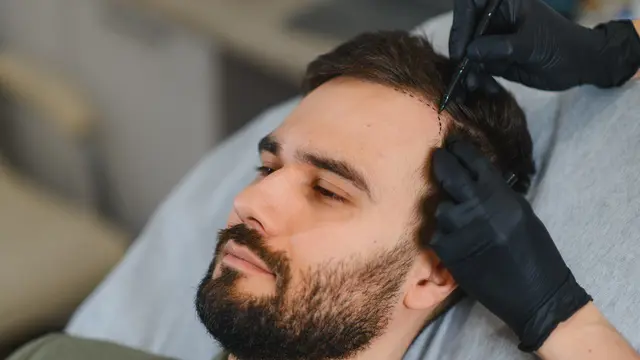
Men's SMP hairline treatment is a staged process rather than a single appointment. Building density gradually across several sessions allows tone and shape to be assessed in natural light between visits and adjusted before anything is finalised. A typical treatment journey involves the following steps.
- Consultation, scalp assessment, and hairline design: the scalp is examined, hair loss pattern and skin condition are assessed, and medical history, medications, allergies, and any previous scalp procedures are reviewed. Goals are discussed frankly, including what SMP can and cannot achieve. A proposed hairline is then drawn directly onto the scalp so it can be seen, photographed, discussed, and adjusted. Nothing proceeds until the design is agreed.
- Preparation and pigment matching: pigment tone is selected to match existing hair colour and skin tone, and diluted as needed so the first session sits deliberately lighter than the intended final result. The area is cleansed and a topical numbing agent is applied for comfort. Baseline photographs are taken for comparison at later visits.
- First micropigmentation session: follicle-sized pigment points are placed across the agreed area, with spacing and depth varied to avoid a uniform, printed appearance. Most sessions take a few hours depending on the size of the zone being treated. Sensation is commonly described as a repetitive light scratching or tapping rather than sharp pain, and comfort is checked throughout.
- Immediate aftercare and same-day expectations: mild redness and slight tenderness across the treated area are normal and usually settle within a day or two, and the pigment initially looks darker and sharper than it eventually will. Showering should be avoided for the first 24 hours, after which the scalp should be washed gently — patted, never scrubbed. Heavy sweating, swimming pools, saunas, steam rooms, and hot bathing should be avoided for approximately one week, and perming or dyeing should be avoided for around one week before and after treatment. Beyond these points, most men resume ordinary daily activity immediately, with no special restrictions required.
- Second and subsequent sessions: follow-up sessions are scheduled once the scalp has settled and the true retained tone can be judged. Each session refines density, adds depth where pigment has faded, and adjusts hairline softness. Most men complete a course of several sessions; the exact number depends on the size of the treated area, skin type, pigment retention, scar tissue, and the density of the desired result.
- Review and long-term maintenance: a review appointment confirms that tone and shape have settled as intended and that no touch-ups are needed. Over subsequent years gradual fading is expected, and a maintenance session can refresh density and, where appropriate, adapt the hairline as natural hair loss progresses.
Downtime: in practical terms, downtime is minimal. Expect mild redness for a day or two, avoid heavy sweating and heat exposure for about a week, and delay washing for the first 24 hours. Ordinary work and social activity can generally resume straight away.
Men's SMP Hairline Results, Safety, and Longevity
A change in appearance is visible immediately after the first session, but the honest answer about results is that the first session is a foundation, not a finished outcome. Pigment settles and lightens over the days following each visit, and the intended density and tone are reached across the full course of staged sessions. Because pigment is deposited in a shallow plane and formulated to soften over time, men's SMP hairline results are best described as long-lasting rather than permanent. Fading occurs gradually over years, influenced by sun exposure, skin type, individual immune response, aftercare, and the depth and density of the original work, and periodic refresh sessions are the normal way to maintain the look. No fixed duration can be promised and no specific result can be guaranteed.
From a safety standpoint, scalp micropigmentation is a non-surgical procedure performed on the superficial scalp, which keeps its risk profile modest compared with surgical hair restoration. Return Clinic's approach is deliberately conservative: hairline placement is agreed in advance rather than improvised, density is built in stages rather than forced in one sitting, single-use needles and sterile technique are standard, and medical history is reviewed before treatment begins. Building gradually is not only an aesthetic preference but also a safety measure, because it is far easier to add pigment at a later session than to remove pigment placed too heavily or too low.
Possible side effects include temporary redness, mild swelling, tenderness, itching as the scalp settles, and occasional small scabbing at pigment points. Less commonly, patients may experience uneven pigment retention requiring correction, or gradual tonal shift as pigment fades. As with any procedure that breaks the skin, infection is possible, and allergic or sensitivity reactions to pigment, though uncommon, can occur. Serious complications are rare but possible. Any increasing pain, spreading redness, warmth, swelling, discharge, or fever after treatment should be assessed by a medical professional promptly. Every candidate should have an individual consultation with a qualified practitioner before deciding whether this procedure is appropriate for them.
Why Choose Return Clinic for Men's SMP Hairline Treatment?

Scalp micropigmentation is widely available, but the gap between a well-planned, medical-standard procedure and a rushed cosmetic one is visible on a man's face every day for years afterwards. Return Clinic approaches men's SMP hairline treatment as a clinical service: patients are screened, medical history is reviewed, hygiene protocols follow clinical rather than salon standards, and every session is documented and photographed so progress can be judged objectively rather than from memory.
That clinical framing is anchored in genuine hospital-grade experience. Dr. Hyung Geon Kim, M.D., Ph.D., trained at Seoul National University College of Medicine, completed fellowship training at Asan Medical Center (AMC), held a professorship at Case Western Reserve University Hospital in the USA, and served as Chief of Internal Medicine and Medical Director at a general hospital. That background shapes how the clinic thinks about patient screening, sterile technique, documentation, and knowing when a patient should be medically evaluated before a cosmetic procedure proceeds.
The clinic's aesthetic philosophy is equally deliberate. A hairline should suit the man wearing it — his facial proportions, his age, and the way his hair loss is likely to continue — rather than follow a template. Designs are drawn and approved before treatment begins, density is built across staged sessions rather than forced into one, and a natural, understated result is always preferred to an aggressive one. The service is also structured to be practical for men travelling from abroad, with staged sessions that can be planned around travel schedules and clear written aftercare that requires no specialist equipment.
Clinic strengths:
- Medically supervised protocols: patient screening, medical history review, sterile single-use technique, and session documentation carried out to clinical standards under the medical leadership of a board-certified specialist physician.
- Design-first hairline planning: every hairline is drawn, reviewed, photographed, and approved by the patient before any pigment is placed, with placement kept conservative and age-appropriate.
- Single-zone or full-scalp flexibility: treatment can address one small area such as M-shaped temporal recession, or extend across hairline, mid-scalp, parting, crown, scars, and full shaved-look coverage.
- Staged, adjustable results: density is built gradually across multiple sessions so tone and shape can be assessed between visits and refined, rather than committed to in a single sitting.
- Compatible with hair transplantation: SMP can be planned before, between, or after transplant surgery to add apparent density, blend graft zones, and camouflage donor and recipient scarring.
Real Patient Experiences
The following are anonymised composite examples reflecting the concerns and outcomes commonly seen with men's SMP hairline treatment. They are illustrative rather than verified individual testimonials, and individual results vary.
M-Shaped Hairline Patient, 30s
He had watched both temporal corners recede over several years and felt that every photograph made his forehead look longer than it was. After a hairline design session and a staged course of scalp micropigmentation across both corners and the frontal border, the transition between temple hair and hairline appeared softer and less exposed. He described feeling more comfortable with shorter haircuts and less inclined to arrange his hair to cover the corners.
Post-Transplant Density Patient, 40s
Following a hair transplant, he was satisfied with growth but frustrated that the scalp still showed through between grafts under bright light, and that a donor-area scar became visible whenever his hair was cut short. Micropigmentation was applied across the frontal and mid-scalp region to reduce scalp-to-hair contrast, with additional sessions targeting the scar. The overall impression of density improved and the scar became less noticeable at conversational distance.
Take the First Step Toward a Defined Hairline
Headline: Your hairline frames everything about your face — and rebuilding it does not have to involve surgery.
Primary CTA: Book your men's SMP hairline consultation at Return Clinic today. In a single appointment your scalp and hair loss pattern will be assessed, a proposed hairline will be drawn directly onto your scalp for you to review and adjust, and your practitioner will explain honestly what scalp micropigmentation can and cannot achieve for your specific pattern, with no obligation to proceed.
[ Book My SMP Hairline Consultation ]
Secondary option: Prefer to speak with someone first? Call our patient coordination desk to reach the Return Clinic SMP consultation team, who can answer your questions about candidacy, session planning, aftercare, and scheduling for international patients before you commit to an appointment.
Individual clinical results and recovery timelines may vary depending on scalp/skin condition and personalized treatment planning. Temporary redness, mild swelling, or tenderness may occur following treatment.
Related Treatments
Explore additional hair restoration, scalp micropigmentation, and skin rejuvenation procedures at Return Clinic.

Liftera-A2 HIFU Lifting
Liftera-A2 HIFU lifting is a non-surgical skin tightening procedure that uses high-intensity focused ultrasound to deliver heat energy to precise depths beneath the skin surface.
Learn More

Medical SMP Hair Loss Care
Scalp micropigmentation occupies a distinct position and is not a substitute for medical or surgical hair-loss management.
Learn More

SMP Hairline
SMP hairline treatment applies this technique specifically to the frontal hairline — the area that frames the face and is usually the first thing both the patient and other people notice.
Learn More