Medical SMP, Stem Cell Hair Restoration & Skin Rejuvenation in Gangnam, Seoul · Multilingual Concierge
1:1 Personalized Care by Dr. Hyung Geon Kim, M.D., Ph.D.
en-US


Hair Loss & Hair Restoration · Consultation Required
Stem Cell Hair Restoration
Stem cell hair restoration is a regenerative, non-surgical approach to hair loss that focuses on the health of the scalp environment in which each hair follicle lives.
Schedule a ConsultationWhat Is Stem Cell Hair Restoration Treatment?

Stem cell hair restoration is a regenerative, non-surgical approach to hair loss that focuses on the health of the scalp environment in which each hair follicle lives. Rather than moving hair from one part of the head to another, the aim is to support the follicles you still have — including miniaturising follicles that are producing progressively finer, weaker hairs — by improving the biological conditions around them. Treatment is delivered directly to the scalp in a clinical setting, under medical supervision, and is planned around the specific pattern and stage of your hair loss.
Who Needs Stem Cell Hair Restoration Treatment?
Hair loss rarely announces itself. Most patients notice it gradually — more hair in the shower drain, a part line that seems wider in photographs, a hairline that has quietly moved back over several years. Candidacy for stem cell hair restoration depends on the pattern, stage, and likely cause of your hair loss, all of which are established during consultation. The following profiles describe patients for whom a regenerative, physician-led scalp protocol is commonly appropriate.
- Adults in their 20s to 60s noticing early or progressive thinning: Regenerative treatment is generally most useful while functioning follicles remain in the affected zone, which is why patients who act at the first signs of change often have more clinical options available to them. Younger patients in their 20s and 30s frequently present with a receding or irregular hairline and want intervention before the change becomes obvious to others. Patients in their 40s to 60s more often present with established thinning at the crown or a widening part, and may be seeking to slow further change while improving the quality of the hair they still have.
- Men with pattern hair loss affecting the hairline, temples, or crown: Male pattern hair loss typically follows a predictable progression, beginning at the temporal recession points and the vertex before the two areas converge. Patients in this group often want treatment that addresses the scalp environment across the whole at-risk region, not only the visibly bald zone. A regenerative protocol can be planned to include areas that are still covered but already showing early miniaturisation, which is a common reason patients choose medical assessment over over-the-counter products.
- Women with diffuse thinning or a widening part line: Female hair loss often presents differently from male pattern loss, with reduced density spread across the mid-scalp rather than a defined receding hairline. Because the change is diffuse, it is frequently dismissed or misattributed for years before medical assessment. These patients benefit particularly from a workup that considers hormonal and nutritional contributors alongside topical and regenerative scalp treatment.
- Patients whose hair shedding may be linked to systemic or internal health factors: Thyroid disorders, anaemia, restrictive dieting, post-illness recovery, chronic inflammatory conditions, and certain medications can all drive shedding. Patients who have experienced a sudden or unusually rapid increase in hair fall, or whose hair loss followed a period of illness or significant physical stress, need a medical evaluation rather than a purely cosmetic one — and this is precisely where the clinic's internal medicine grounding is most relevant.
- Patients who have tried topical or over-the-counter products without meaningful change: Many patients arrive having cycled through shampoos, supplements, and home devices for a year or more. This group is typically looking for a clinical explanation of what is actually happening at follicle level and a supervised plan with defined review points, rather than another product to try.
Meet the Specialist in Hair Loss & Hair Restoration
Hair restoration at Return Clinic is delivered within a physician-governed clinical framework. Because hair loss so often reflects internal health, the clinic's medical leadership is grounded in internal medicine — an unusual and deliberate foundation for an aesthetic hair programme.
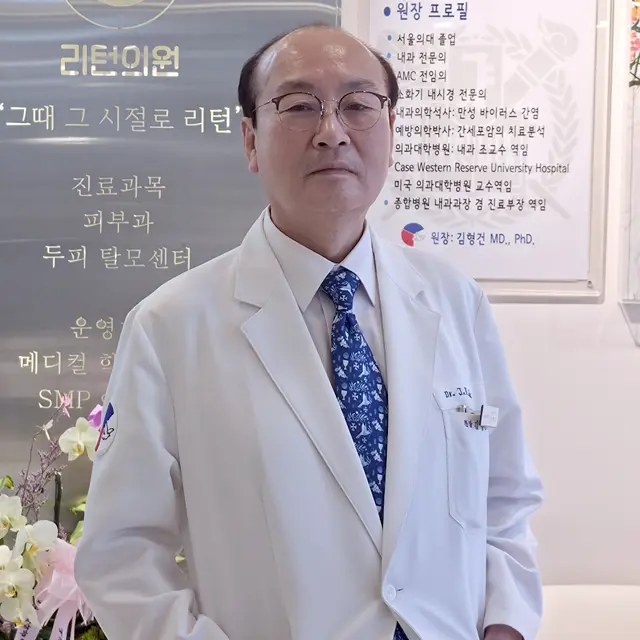
Dr. Hyung Geon Kim, M.D., Ph.D. — Medical Leadership
Dr. Kim is a board-certified Internal Medicine specialist and a certified Gastrointestinal Endoscopy subspecialist, and a graduate of Seoul National University College of Medicine. He completed fellowship training at Asan Medical Center and holds a Master's Degree in Internal Medicine, with research in chronic viral hepatitis, and a Ph.D. in Preventive Medicine, with research analysing hepatocellular carcinoma treatment.
His career includes appointments as Assistant Professor in the Department of Internal Medicine at a medical university hospital, Professor at Case Western Reserve University Hospital in the USA, and subsequently Chief of Internal Medicine and Medical Director at a general hospital. His clinical specialties are gastroenterology, upper and lower endoscopy for diagnosis and treatment, liver disease including chronic hepatitis B and C, liver cirrhosis and fatty liver disease, the diagnosis and treatment of hepatocellular carcinoma, and general gastrointestinal disorders. He is a certified Gastrointestinal Endoscopy Subspecialist with the Korean Society of Gastrointestinal Endoscopy (Certification No. 99-533, valid 1 August 2025 – 31 July 2030), and holds membership of the same society.
Within the hair restoration programme, Dr. Kim's role is one of medical governance and whole-patient oversight rather than direct aesthetic delivery. His internal medicine background informs the clinic's insistence that hair loss is screened for systemic contributors — nutritional, hormonal, hepatic, and general medical — before a regenerative protocol is designed. Decades of academic and hospital-level practice, including a professorial appointment in the United States and directorship of a general hospital, underpin the documentation standards, consent processes, and safety protocols applied to every treatment.
Stem Cell Hair Restoration Treatment Areas and Expected Improvements
Stem cell hair restoration is planned zone by zone, because different regions of the scalp thin at different rates and respond differently. The following areas are commonly addressed, either individually or as part of a combined plan. Treatment may cover a single partial area or the full affected region, depending on assessment findings.
- Frontal hairline: The hairline frames the face and is usually the first area a patient notices changing. Treatment here focuses on the zone of miniaturising follicles just behind and along the existing hairline, where hairs have become progressively finer and shorter rather than disappearing entirely. Because the hairline is the most visually scrutinised region of the scalp, planning prioritises a soft, irregular, natural-looking border rather than a rigid line, and the density goal is set in proportion to the patient's facial structure and existing hair character.
- Temporal recession zones: The temples recede in a characteristic pattern in male pattern hair loss and can also thin in women, particularly with hormonal change. This region often shows early follicular miniaturisation while still appearing superficially covered, which is why it is included in assessment even when the patient's stated concern lies elsewhere. Addressing the temporal zones can help maintain the overall shape of the hairline, since recession here changes the perceived proportions of the forehead considerably.
- Mid-scalp and part line: Diffuse thinning across the mid-scalp is the most common presentation in women and a frequent secondary finding in men. The clinical marker patients notice first is a part line that appears to widen over time, or scalp becoming visible under direct overhead lighting. Treatment across this zone aims to support hair calibre and scalp condition broadly rather than to target a single defined patch, and improvements here often read as better overall coverage rather than a change in hairline position.
- Crown and vertex: The crown thins in a roughly circular pattern and is difficult for patients to monitor themselves, which means it is often more advanced at presentation than the patient expects. The whorl pattern of hair growth at the vertex makes any loss of density disproportionately visible, because the hair naturally separates around a central point. Treatment planning for this area accounts for the fact that the crown frequently responds more slowly than the frontal scalp, and expectations are set accordingly during consultation.
- Post-transplant and surrounding native hair: Patients who have undergone a hair transplant retain native, non-grafted hair around and between the grafted follicles, and that native hair continues to be subject to ongoing pattern loss. Supporting the scalp environment in these surrounding areas is a common reason for regenerative treatment after surgery. This is discussed as supportive care for existing hair, not as a treatment that alters the grafted follicles themselves.
- Overall scalp health and condition: Beyond density, scalp condition itself — oiliness, dryness, irritation, flaking, and general tissue quality — affects how comfortable the scalp feels and how well hair sits and behaves day to day. Assessment includes scalp condition as a treatment target in its own right, since a compromised scalp environment works against every other intervention a patient might pursue.
Stem Cell Hair Restoration Treatment Process and Timeline
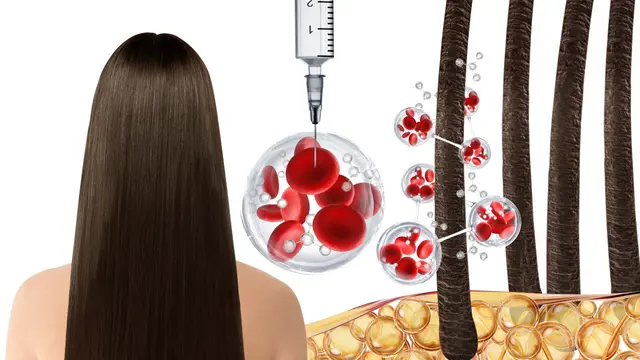
The treatment pathway at Return Clinic is structured, staged, and documented. The following outlines what a typical course involves, though the specifics are always tailored following assessment.
- Medical consultation and hair loss history: Your first appointment is a clinical consultation, not a sales conversation. The physician takes a full medical history covering the onset and pattern of your hair loss, family history, medications, recent illness or significant physical stress, dietary patterns, and any relevant systemic symptoms. Where indicated, screening for internal contributors to hair shedding is discussed, reflecting the clinic's internal medicine foundation. This step establishes whether your hair loss has a treatable underlying medical driver that should be addressed in parallel.
- Scalp and hair assessment: The scalp is examined directly, zone by zone, to map the distribution and stage of thinning, assess hair shaft calibre, and evaluate scalp condition. Standardised photographs are taken at this stage to provide an objective baseline, since reliable assessment of any hair treatment depends on comparing like with like at defined intervals rather than relying on recollection.
- Individualised protocol design: Based on the findings, your physician designs a treatment plan specifying which zones will be treated, the number and spacing of sessions anticipated, and whether complementary options such as Scalp Micro Pigmentation are appropriate. Where an autologous approach is selected, the harvest step, its source, and its implications are explained fully and specifically during this discussion, and written consent is obtained before anything proceeds. Anything that is not clinically indicated for your presentation is left out of the plan.
- Treatment session: Sessions are performed in-clinic by the treatment team. The scalp is cleansed and prepared, comfort measures are applied as appropriate, and the protocol is delivered to the mapped treatment zones. Most patients describe the sensation as tolerable, and sessions are scheduled to fit within an ordinary day rather than requiring time off.
- Immediate aftercare: You will typically be advised to avoid washing the scalp for approximately 24 hours after treatment, and thereafter to wash gently — using fingertips rather than nails, with the scalp handled softly rather than scrubbed. Alcohol is generally to be avoided immediately after treatment, as is heavy sweating from vigorous exercise, swimming, saunas, and hot baths for the first 24 hours. Direct sun exposure and heat should be limited for approximately one week. Beyond these straightforward precautions, most patients return to normal daily life immediately.
- Follow-up and review: Follow-up appointments are scheduled at defined intervals with repeat standardised photography, allowing objective comparison against your baseline. Because the hair growth cycle operates over months, meaningful assessment generally begins several months after the start of treatment rather than after a single session, and the plan is adjusted at review based on what the photographic and clinical findings actually show.
Downtime: Formal downtime is minimal. Mild redness, tenderness, or a sensation of scalp tightness in the treated area is common in the first day or two and generally settles without intervention. Minor bruising or swelling can occur. Patients are asked to report anything unexpected — particularly persistent pain, spreading redness, or discharge — promptly rather than waiting for a scheduled review.
Stem Cell Hair Restoration Results, Safety, and Longevity
How long do results last? Hair loss is a progressive condition, and no regenerative treatment stops that biological process permanently. Any improvement in hair quality or density achieved through treatment exists against a background of ongoing genetic and hormonal influence, which means maintenance is a realistic part of long-term planning rather than a sign that treatment failed. Duration of benefit varies substantially between individuals and depends on the underlying cause of the hair loss, the stage at which treatment began, and whether systemic contributors have been identified and managed. Your physician will discuss a realistic maintenance framework for your case rather than quoting a fixed duration that cannot be substantiated for every patient.
Safety profile: The regenerative approach used at Return Clinic is minimally invasive and scalp-directed, without surgical incision or excision. Where an autologous approach is used, cells originate from the patient's own body, which avoids the compatibility considerations associated with non-autologous material. The clinic's conservative treatment philosophy means protocols are matched to clinical need rather than escalated by default, and patients are not treated in zones where treatment is not indicated. All procedures are performed within a physician-governed framework, with documented consent, defined protocols, and structured follow-up — standards that reflect the Medical Director's background in hospital-level internal medicine practice and medical directorship.
Possible side effects: As with any procedure involving the skin and scalp, side effects are possible. Commonly reported effects are mild and short-lived: temporary redness, tenderness, swelling, itching, minor bruising, or a sensation of tightness in the treated area. Less commonly, patients may experience prolonged discomfort or a localised reaction. Infection is uncommon but possible with any procedure that breaches the skin surface, and is minimised through sterile technique and aftercare compliance. Serious complications are rare, but they are not impossible, and no clinic can eliminate risk entirely. Any procedure carrying a benefit also carries a risk profile, and you are entitled to have both explained in full before consenting.
Is stem cell hair restoration suitable for everyone? No. It is not appropriate for every patient or every pattern of hair loss. Patients with certain active scalp conditions, specific medical diagnoses, particular medications, or hair loss driven by an untreated underlying illness may need that condition addressed first, or may be better served by a different approach altogether. Advanced hair loss with very few remaining follicles in the target zone is unlikely to respond well to a regenerative protocol, and patients in this situation deserve to be told so directly rather than sold a course of treatment. Suitability is determined at consultation, and Return Clinic will advise against treatment where it is not clinically justified.
Why Choose Return Clinic for Stem Cell Hair Restoration and Regenerative Hair Loss Care?

Return Clinic approaches hair restoration from a genuinely medical starting point. The clinic's Stem Cell and Dermatology departments operate under the governance of a board-certified Internal Medicine specialist with a Ph.D. in Preventive Medicine, an academic career spanning appointments in Korea and the United States, and prior service as Chief of Internal Medicine and Medical Director of a general hospital. That governance shapes how the hair programme is run: with proper history-taking, screening for systemic contributors, documented protocols, and honest counselling about what treatment can and cannot deliver.
This matters practically for patients. A significant proportion of hair loss presentations involve a contributing internal factor — nutritional, hormonal, inflammatory, or medication-related — that a purely cosmetic assessment will overlook entirely. Treating the scalp while ignoring the reason the scalp is struggling is an incomplete answer, and often an expensive one. Return Clinic's structure is designed specifically to avoid that gap.
The clinic also maintains a complementary Scalp Micro Pigmentation service, delivered as a medical tattoo procedure using specialised pigment and technique. SMP addresses the appearance of density directly and can be applied to a single partial area or the full scalp region, used to define an irregular or receding hairline, or combined with a hair transplant to complement the surgical result. It is also an option for patients with very limited remaining hair, for whom regenerative treatment alone has less to work with. Where SMP is appropriate, it is presented as a distinct option with its own indications — not bundled in automatically.
Clinic USPs:
- Physician-governed regenerative care under a board-certified Internal Medicine specialist and Ph.D. in Preventive Medicine: every hair loss plan is built on a medical assessment of the whole patient, not a cosmetic assessment of the scalp alone.
- Academic and hospital-level clinical standards: protocols, consent, and documentation reflect the Medical Director's professorial appointments in Korea and the USA and prior role as Chief of Internal Medicine and hospital Medical Director.
- Integrated Stem Cell and Dermatology departments: regenerative scalp protocols and dermatological scalp care are delivered within one clinical framework, with complementary Scalp Micro Pigmentation available where clinically appropriate.
- Conservative, treat-only-what-is-indicated planning with structured follow-up: standardised photographic review at defined intervals, and a stated willingness to advise against treatment where it is not justified.
- 1:1 personalised care from consultation through follow-up, with clear aftercare guidance and accessible support for patients travelling from overseas for treatment in South Korea.
Real Patient Experiences
The following are anonymised, composite examples reflecting the patient profiles and treatment pathways described above. They are illustrative of typical clinical presentations and are not individual testimonials or guarantees of outcome. Individual results vary.
Diffuse Thinning and Widening Part, Female, 40s
This patient presented after noticing that her part line appeared progressively wider in photographs over roughly two years, with increased shedding during washing. Consultation included a full medical history and discussion of possible systemic contributors alongside scalp assessment, and a staged regenerative protocol was designed for the mid-scalp with structured photographic review. At follow-up she reported that shedding felt less pronounced during washing and that her hair held styling more readily, with the comparison photographs providing the objective reference point for ongoing planning.
Early Hairline Recession and Crown Thinning, Male, 30s
This patient sought assessment after two years of using over-the-counter products without noticing meaningful change, concerned primarily about his temporal recession and secondarily about the crown, which a family member had pointed out to him. Assessment mapped early miniaturisation across both zones, and a regenerative protocol was planned to cover the at-risk region rather than the visibly affected area alone, with realistic expectations set for the crown given its typically slower response. He described the treatment sessions as manageable within a normal working day and returned to routine activity immediately, following the standard scalp aftercare guidance.
Book Your Stem Cell Hair Restoration Consultation at Return Clinic
Your hair loss deserves a diagnosis before it deserves a treatment: let's find out what's actually happening.
Primary CTA — [Book Your Physician-Led Hair Loss Consultation] : Begin with a comprehensive one-to-one medical consultation at Return Clinic, where your hair loss history, scalp condition, and possible internal health contributors are assessed together before any stem cell hair restoration protocol is recommended. You will receive standardised baseline photography, a clear explanation of your options in South Korea, an honest discussion of what treatment can and cannot achieve for your specific pattern of hair loss, and a written plan with defined follow-up review points. If treatment is not clinically appropriate for you, we will tell you so directly.
Secondary option — Call our Hair Restoration Appointment Desk: Speak directly with our patient coordination team to arrange your consultation, ask questions about the assessment process, discuss scheduling for international patients, or request a call back from the clinical team. Telephone: \[Clinic contact number\]
This page is intended for general information and does not replace individual medical advice. Diagnosis and treatment decisions should be made in consultation with a qualified physician following personal assessment.
Individual clinical results and recovery timelines may vary depending on scalp/skin condition and personalized treatment planning. Temporary redness, mild swelling, or tenderness may occur following treatment.
Related Treatments
Explore additional hair restoration, scalp micropigmentation, and skin rejuvenation procedures at Return Clinic.

Liftera-A2 HIFU Lifting
Liftera-A2 HIFU lifting is a non-surgical skin tightening procedure that uses high-intensity focused ultrasound to deliver heat energy to precise depths beneath the skin surface.
Learn More

Medical SMP Hair Loss Care
Scalp micropigmentation occupies a distinct position and is not a substitute for medical or surgical hair-loss management.
Learn More

SMP Hairline
SMP hairline treatment applies this technique specifically to the frontal hairline — the area that frames the face and is usually the first thing both the patient and other people notice.
Learn More